Showing posts with label Langley Local Food. Show all posts

Wednesday, November 6, 2013

If our economy should grind to a halt...I’ll still plant beans for the winter

Chris finally finished shelling our beans--fresh shelled beans filled the freezer, and dried beans will be for seed, and also for eating. Big white creamy Italian cannellini beans, and Rockwell, a 100-year-old purple and white heirloom, native to Whidbey Island, that cooks up similar to a pinto.  


"For the past several nights I’ve been shelling black beans. Hours of my time have been spent snapping these brittle husks to try and fill what seems to be a bottomless bowl. It’s not like I’m creating any economic stability for my family here. Lets say that I could shell three pounds of beans in an hour (which I can’t). I can buy organic beans for $.80 a pound. That would give me a net worth of $2.40 an hour and that doesn’t include spreading compost, planting, cultivating, and harvesting. So why waste my time? Several reasons really. First, it feels right. Work the ground, add some seed, water, light, work, and love, and I’ve got nourishment for my family though the winter. Second, beans are an important rotation crop for the fields, as they build fertility. Third, I don’t believe that I can even buy beans of this quality. Besides the biodynamic preps, I’ve known and tended them their entire life. Fourth, it’s real, or I should say it grounds me. It brings me closer to reality. If we run out of oil, if our economy should grind to a halt, if the lights of the city flicker and are extinguished, I’ll still plant beans for the winter. And fifth, I have rarely seen the true correlation between the actual value of real food and the work that it takes to create it reflected in its actual price.

Some things cannot be expressed in terms of monetary value. Their worth actually transcends it. It is both priceless and free, depending upon the circumstances."

Excerpted from Awakening to Nature: Gardening and Nature Observation as a Path of Spiritual Development, Chris Korrow


Rockwell Beans, heirloom native to Whidbey Island.  

Tuesday, October 1, 2013

Eat your greens--Six ideas!

Here are our suggestions for how to use the greens which are now being harvested and are for sale on the farm stand!

GREEN IDEAS

ESCAROLE
Considered a bitter green, don’t let that deter you. This is a mild green with FLAVOR. Chris’s mom was Italian, and she always made a traditional in Italian chicken soup, just chop the escarole and cook well. OR--slice head down the middle lengthwise, braise in a skillet with hot olive oil, serve with lemon, garlic, chopped walnuts and parmesan cheese.


SWISS CHARD
Great substitute for spinach in cooked dishes. Chop the stems and stalks, cook until soft before adding the greens to cook until tender.


COLLARDS
Like kale, it holds up well in hearty soups and stews. Delicate brassica flavor and nice texture. Cook well in a little water, drain. For a southern favorite drizzle bacon grease and a splash of vinegar or California style with olive oil, chopped garlic, and salt.


MUSTARD
Surprisingly light, but with a wonderful extra zing. Great in stir-frys combined with other veggies. Try adding a scoop of black bean paste. We like them well cooked in with a pot of beans (with ham or vegetarian).


KALE
Smoothie and massaged kale salad are our two favorite ways to eat kale. It holds up well in hearty soups and stews.

ARUGULA
Great in salads, or substitute for basil in your favorite pesto recipe then serve fresh on baked winter squash!

Thursday, August 8, 2013

Front Yard Farm Stand or How Farming Followed Us to Whidbey Island


This is the fourth day of our new Front Yard Farm Stand. It has a nice ring to it. The table is filled with garlic, green beans, broccoli, cabbage, cauliflower, beets, and kale.

Two years ago when we sold our farm of twenty-plus years, and chose village life on an island in the Puget Sound, I thought we would leave farming behind. We would become the prosperous supporters of local farms, the city dwellers who turn their front yard into a garden, living a life of urban semi-self sufficiency. This felt like a relief to me, after an entire adult life committed to rather radical self sufficiency, including putting two children through cloth diapers with no washer or dryer, no indoor toilet, really living off the grid on the food grown by us and our neighbors. It was a good life. Nevertheless, our daughters grew up and Chris and I decided it was time to move to “town.” I am now a five minute walk from the best latte in the world, Yes, it’s true, many people who have traveled through Europe say they have not had a better espresso or cappuccino than that served by at Des at Useless Bay Coffee Company. But, I digress, such are the distractions of lively village life.

No sooner had we arrived, and in fact before we rented our first house in Langley, Chris had secured a plot in the local Community Garden at the Anderson Farm, turned the soil, planted seeds. My mind traveled back to the first weeks on our farm; we were living in a tent. The first work project was planting pecan trees, and the first structure built was a green house. Priorities.

And now, twenty-five years later, here we were, planing a garden before we had a home. Word spread that Chis had been a farmer, and a few people started to offer him land on which to farm. A minute later, he was on a plane, returning home to Kentucky retrieve his tractor and other farm equipment.

So, here we are again. Drying onions and garlic are strewn about the yard, our extra bedroom served as storage for a bumper crop of squash. The fridge is filled with goat milk, wine, local sausages, and cheese, all “purchased” from neighbors or local merchants in exchange for Chris’s vegetables grown just up the road a piece, at his market garden on the Anderson Farm.

We still puzzle with the real-number economics of farming—fully embracing the ideal of local food production, but also too experienced to ignore the reality that a $3 head of lettuce probably took $20 to produce. A young couple we know puts in 60 hours a week each on their CSA farm. Maybe they gross $30-40k? We wonder when the social and environmental value of local food will catch up with the economic value.

But, we keep at it. It turns out, farming followed us here.

And thus we have the new Front Yard Farm Stand. Please stop by and pick something up for dinner!

—Christy Korrow

Monday, April 15, 2013

Chris Tills the Ground for School Garden

Chris drove the tractor down Maxwelton Ave. to spade up some new beds for a school garden! Children will learn about science and sustainability while growing vegetables for Good Cheer Food Bank. Read all about it here!


Sunday, September 9, 2012

What's For Sale?

Chris still has a few slots open for those who want to sign up to buy vegetables from now, through fall and winter.

Call him at 221-0430 or email 90acres@whidbey.com.

The two regular pick-up days are:
Thursdays from 4 – 6 pm
Saturdays from 10 am – 12 pm

If you cannot come on one of those two days, Chris can make other arrangements with you. He can schedule a pick-up on another day, or orient you to the garden so you can come and harvest your own food, and note what you picked on a ledger pad he will keep in the shed. You can pay in advance and buy down your credit, or note what you take and he will invoice you at the end of the month.

Here is is current list of fantastic organic/biodynamic veggies: 

Lettuce
Lettuce Mix
Diakon radish
Mustard
Spinach - is going crazy!
Snow Peas
Sugar snap Peas
Carrots - (let me know if you want some, I have them at my home garden)
Kale (three different varieties)
Swiss Chard
Bok Choy
Potatoes
Patty Pan Squash
Zucchini
Parsley
Cutting Celery
CeleryKohlrabi
Cauliflowers, Broccoli & Cabbages in the next week or so.

Saturday, September 8, 2012

Gardening Class: Demystifying Biodynamic Gardening

Sunday, September 16
From 12 – 2pm


Where:
Market Garden at the Anderson Farm, the corner of Fairgrounds Road and Al Anderson Avenue (next to the Langley Community Garden P-patch)

Most gardening and farming practices use material inputs (npk) when trying to improve plant health. Biodynamic farming and gardening takes into consideration the interconnectedness of all life in and around the farm and garden, with the understanding that we are looking for living nutrients when we want to grow nutritional food for people.

Chris Korrow will explore these relationships and how they make a difference in plant health and soil fertility. Topics such as companion planting, plant spacing, micronutrients, planting though the seasons, biodynamic compost, how to deal with early bolting, and the connection between water, soil and temperature will also be discussed.

$15 includes biodynamic preparations that you can take home and use in your own garden!

For more information email 90acres@whidbey.com or call 221-0430.

Preregistration requested, there is room for a limited number of participants.

Chris is developing a membership garden for those who want to buy produce from now through winter (he will focus on fall and winter production). More info will be available, or you can sign up at the event. Vegetables will be available for sale at the class.

Tuesday, July 31, 2012

Biodynamic Preps and Giant Potato Plants


—Christy Korrow

Chris is charged up about his market garden. He is on track to have crops for sale beginning in early October, and hopes to supply customers through the winter. His plan is to create a membership garden—somewhere between a farm stand and a CSA.

He likes the idea of people becoming members at a $50 fee. It gives him the security of knowing he has a dedicated customer base. It will also give the customers more flexibility than a CSA—more choice of variety, how much they want to spend, and flexibility time-wise. He hopes he can orient people to the garden to the point where they can even go in and harvest on their own, and write down what they take in a note book, using an honor-based credit system.

He has a few members already and the space is limited, so email him if you’re interested!


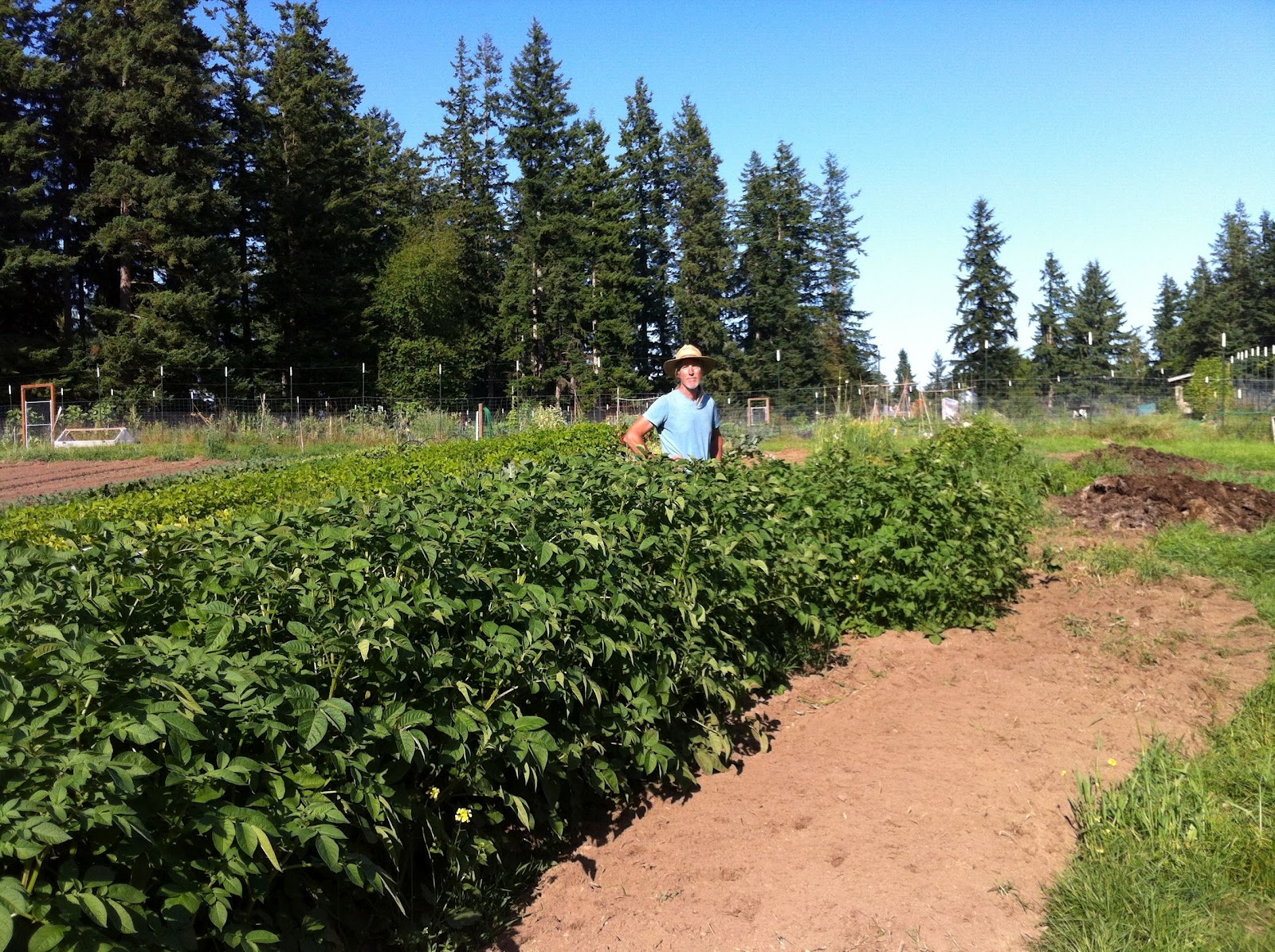
He can’t believe how well the vegetables are doing. The potato plants are the biggest he’s ever grown—waist-high. He planted a local variety that our friend has been growing on the Chinook land for many years. Squash and eggplants are also bigger than we've ever seen. Healthy, too!


The peas are harvested, shelled and in the freezer!

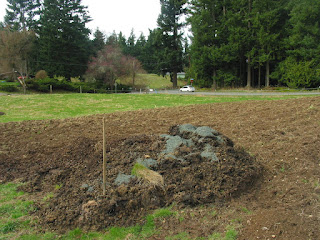
Chris feels that the plot is performing so well in large part due to the amount of biodynamic preparations he has used—particularly the Pfeiffer Compost Starter and its effects on the horse manure he used. We have also done two sprayings of horn manure, one barrel compost, and we used compost preparations in the pile. Chris also did some spraying of fermented horse tail tea that we made last fall, as a preventative for mold.


I am behind on spraying silica, but am committed to doing at least two in August and early September. I just purchased a unit of BD #501 gold, this is horn silica with potentized gold mixed in! I also have my own homemade silica prep, made from the crystals on our farm back in Kentucky.


Our horns are still buried in the garden. I need to check those in the next day or so. Normally one would dig them up in early June, but with the cool Northwest spring, they were still green inside. I wrote to Hugh Courtney, my friend and colleague from the Josephine Porter Institute and asked his thoughts on leaving the horns in the ground. He replied, “Remember that Steiner says of the BD #500 (horn manure) that they can be left in the ground until you are ready to use them. (Not so for BD #501 (horn silica), because leaving them in over the winter totally changes the forces picture in a Sensitive Crystallization test as Harvey Lisle demonstrated to both of us once upon a time.) So summer forces do not affect BD #500, and the daily in breath of the Earth is akin to the winter forces needed to transform BD #500.”


Chris is planning to do a class soon. Email him if you want to be notified when one is scheduled!

Saturday, July 21, 2012

Chris Sells Vegetables in Langley!


Chris planted quite a few trials this summer, testing varieties in preparation for a commercial scale market garden that will serve neighborhood customers beginning in early October, continuing through the winter.

He had enough excess cauliflower and cabbage to set up a table yesterday at the Second Street Market in downtown Langley.

It was a great chance for Chris to begin to share the news of the new Market Garden at the Anderson Farm, located at the corner of Al Anderson Ave and Fairgrounds Road.


 His plan is to create a membership-based garden, somewhere in between retail sales and a CSA. He is looking for a committed group of about 25 customers who will join the garden for a one-time fee, this will entitle members to purchase produce during regular weekly hours, or they can come and harvest on an honor-based system, once oriented to the garden.


Only organic and biodynamic agricultural practices are used.

If you would like more information, please call 221-0430 or email Chris at 90acres@whidbey.com.


Wednesday, March 21, 2012

Chris's New Farming Adventure!


—Christy Korrow

Exciting news from Chris! After relocating from Kentucky, our home for the last 20 years, we have been warmly welcomed by the wonderful community of Langley, on south Whidbey Island, Washington. We had not planned to farm commercially here on Whidbey, though we knew we would still be growing a large family garden.

After being here just a short time, Chris had three people offer him farmland where he could develop a market garden. The offer was too good to pass by! In December, we bought him a one-way ticket to Kentucky, where he rented a large Budget rental truck, loaded up our tractor, bush hog, front end loader and Italian spading machine, braved the icy mountain roads, hauling the equipment back to Whidbey.

Fast forward to the first day of spring...

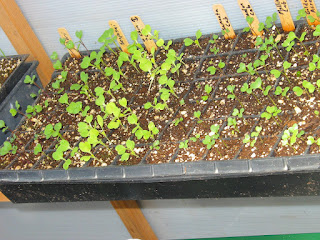
A hot box is now built up against the rental house where we live, filled with seed flats-- flowers, brassicas, early tomatoes and herbs.


Chris will be developing a 1/3 acre market garden in the city limits of Langley, on the property of the Anderson Family Farm. Dorothy is the third generation to tend this family farm. The farm is home to the Langely Community Garden, beginning its third year. Twenty families/individuals each tend an 18 x 18 foot plot. There is also a group who manages a small herd of milk goats, another group who raises chickens and there is a heifer and a young steer being raised for beef. Compared to running our own farm, it is a welcome change, and such an honor to have the opportunity to participate in this kind of community run farm, where many hands make light work.

The ground is about turned, and I just sprayed the first barrel compost on the soil, to celebrate the first day of spring and to welcome in Persephone's return.


The field is a sandy loam, with predominantly rhizome grass, which will be determined to keep growing, even after it has been plowed up. Chris is going to plant cover crops this spring, and plans to get the vegetables going later in the summer. The growing season is quite long here, and though the winters are quite dark, the temperatures remain mild, making it easy to grow into an extended summer season, fall and on into winter time. Our spinach patch thrived uncovered all winter, as did our cabbages. The vegetables don't grow much during the winter, but they hold well. It seems similar to what we are used to with our winter growing in Kentucky.

The land is on the corner of two somewhat well-traveled roads. Chris is planning to keep marketing simple, and by word of mouth, people will know that he is there in the field on certain days of the week. Maybe we'll try an honor system farm stand as well.

I honestly have to say I have mixed feelings about selling food again after so many years. On one hand, I am firmly committed to local food security, I believe it is one of the most important necessary social deeds for our time. I am also keenly aware of the continuing price disparity between what we pay for food on the grocery store shelves, and what kind of price a farmer can ask for vegetables so that he or she can actually come close to making a living wage. The joy of knowing we will be producing food for the community, the excitement of experimenting in a new climate where daylight goes on until after 9pm in the summer, to grow food in the city limits of a town, and be part of such an active community farm are the thoughts I am holding onto for now....
Wednesday, September 14, 2011

Biodynamic Gardening Class on Whidbey Island


Biodynamic Gardening and Farming
Workshop for Beginners
with Chris Korrow

Gardening with biodynamics and understanding what nature is telling us about our gardens.
Plus, making and spraying biodynamic preparations, Barrel Compost and Horn Manure (BD #500).

When: Saturday, September 24, 2011, 11am-early afternoon

Where: Langley Community Garden
(Anderson Family Farm: 1041 Al Anderson Ave, Langley, WA 98260), Whidbey Island

Call: 221-0430 (local) or 270-406-9116 (mobile)
Email: 90acres@accessky.net

Bring: A chair if you think you might need one, sun hat and water.

Cost: Fee by donation. Farm interns are free.

Chris has been farming and gardening organically and biodynamically for more than 20 years.
Learn more about Chris at www.breathedeepproductions.com

Friday, September 2, 2011

Random Localness


This yummy sauce is made here on Whidbey Island.


Gabbi and I picked blackberries today, she made tarts and cobbler.


Chris picked this horsetail yesterday, so we brewed up a big vat of tea for the garden. It's one of the nine biodynamic preparations, also known as BD #508. It helps combat fungus and mold, and regulates water forces. We'll spray it on plants, and use some in the compost piles.


Amy gave us these big green apples from her tree on Maxwelton. I can't remember what they are called. They taste like a yellow apple! So crisp and sweet.