Showing posts with label gardening. Show all posts

Thursday, June 26, 2014

Next Steps for Dancing with Thoreau and Viewer Comments!

DANCING WITH THOREAU

A new film by Chis Korrow, creator of Garden Insects

After a successful premiere at the Clyde Theater on Whidbey Island, 
Dancing with Thoreau is now entering the film festival circuit!

"Dancing with Thoreau is a work of art that honors the artful in nature. Korrow’s use of still photos, interviews, quotations and moving images provide a means by which to enter the timelessness he feels is essential to a fulfilled and meaningful life."—Dianna MacLeod, Whidbey Life Magazine

Like our page on Facebook to stay up to date 
or subscribe to our email updates in the upper right-hand corner of this blog 
(you will only be emailed when we post an update!)

Viewer comments...
"Let me first compliment you on the film. To say my wife, sister and I thoroughly enjoyed it would be an understatement. We were inspired and encouraged. When we left the theater a butterfly flashed from across the street. It allowed us to get quite close and actually touch it."—Gary Piazzon, Whidbey Environmental Action Network

[Chis Korrow is] such a keen observer--the footage and narration of the crows at the beginning was just stunning. In fact, all of the images were breath-taking. Hope the film and its message will find its way around the world. —Susanne Fest, PhD, Antioch University Midwest

"I was very moved by your movie... so much so that I have gone out each morning since to the wetlands by my house to listen and see the amazing life that awakens with the dawn. Thank you for producing something so beautiful and compelling that will help many of us Remember…"

“May the film benefit many sentient beings.”

“This ever deepening breathe of fresh air will etch new conscious awareness...” 

Monday, May 26, 2014

Several Supper Suggestions to Savor Spring Spinach OR Why we're having frozen pizza with black olives and spinach for dinner

Most weeks, I make tentative dinner menu for each night of the week. It's not an elaborate process, I just jot down four - six entrees. Most nights I cook dinner, and so it simplifies my life to plan ahead in this way. One less thing to think about! I am married to a farmer, so dinner always centers around what's coming out of the garden. If there is one thing coming on strong, then we are happy to eat ridiculous amounts that vegetable night after night. It's just what we do.

As springtime yields to summer, variety arrives. But right now, it's all about the spinach. The spinach is not only happening, the patch is--dare I say--opulent with oversized leathery leaves, which means we are devouring big bags of spinach everyday until it sends up its seed stalks. 


This week's list of dinner menu items looked something like:
--spinach soufflé (made this, it's a family favorite--I use the Joy of Cooking recipe but I double it),
--spinach quiche (another egg recipe, we're egg customers of neighbors Rebecca and Barb, but this got axed from thus week's menu--I've been too busy/lazy to do the crust),
--steamed spinach with orzo browned in toasted garlic and kale tops (added plenty of Parmesan to this--yum),
--spinach with lamb sausage over rice (haven't made this yet, but we buy artisan LinkLab sausage, made in Seattle, from 2nd Street Wine Shop),
--Rockwell beans with spinach (Chris froze more quarts of this local heirloom as shelly beans than I could count), and last but not least,
--ramen soup with, yes, you guessed it, lots of spinach.

But this evening, I am tired! I'm training for a half marathon so started my Sunday with a six-mile run. I headed up to our property and spent about four hours with our land partners staking out the lot sites in what will become Upper Langley Affordable Housing Community. Chris has been working like crazy getting the gardens going and finishing his movie, Dancing with Thoreau, while also overseeing the heavy equipment operators working on our housing project.

So tonight, we bought a frozen cheese pizza from The Goose, our community grocer, which we will lovingly adulterate with sliced black olives and the spinach Chris brought in, still dripping wet with rainfall.

Wednesday, November 6, 2013

If our economy should grind to a halt...I’ll still plant beans for the winter

Chris finally finished shelling our beans--fresh shelled beans filled the freezer, and dried beans will be for seed, and also for eating. Big white creamy Italian cannellini beans, and Rockwell, a 100-year-old purple and white heirloom, native to Whidbey Island, that cooks up similar to a pinto.  


"For the past several nights I’ve been shelling black beans. Hours of my time have been spent snapping these brittle husks to try and fill what seems to be a bottomless bowl. It’s not like I’m creating any economic stability for my family here. Lets say that I could shell three pounds of beans in an hour (which I can’t). I can buy organic beans for $.80 a pound. That would give me a net worth of $2.40 an hour and that doesn’t include spreading compost, planting, cultivating, and harvesting. So why waste my time? Several reasons really. First, it feels right. Work the ground, add some seed, water, light, work, and love, and I’ve got nourishment for my family though the winter. Second, beans are an important rotation crop for the fields, as they build fertility. Third, I don’t believe that I can even buy beans of this quality. Besides the biodynamic preps, I’ve known and tended them their entire life. Fourth, it’s real, or I should say it grounds me. It brings me closer to reality. If we run out of oil, if our economy should grind to a halt, if the lights of the city flicker and are extinguished, I’ll still plant beans for the winter. And fifth, I have rarely seen the true correlation between the actual value of real food and the work that it takes to create it reflected in its actual price.

Some things cannot be expressed in terms of monetary value. Their worth actually transcends it. It is both priceless and free, depending upon the circumstances."

Excerpted from Awakening to Nature: Gardening and Nature Observation as a Path of Spiritual Development, Chris Korrow


Rockwell Beans, heirloom native to Whidbey Island.  

Thursday, October 24, 2013

New Film: Dancing with Thoreau!


About the film

Dancing with Thoreau is an upcoming feature film about our connection with nature, and specifically the benefits of a connection with nature. The film will explore how and why we, as a Western society, can and should reconnect with our environment.

How does a connection with our natural environment strengthen our spiritual, physical, creative, economic, and intellectual pursuits? How can the cultivation of a spiritual outlook and practice support a healthy and balanced natural environment?

Dancing with Thoreau will weave Chris's film footage and photography from dynamic natural environments across the country together with commentary from leading edge teachers, naturalists, farmers, scientists, spiritual leaders, and representatives of major religions as we explore these questions.
Climate scientists tell us we might be heading toward irreversible climate change, and so many of us do our best to “go green.” Through this film, we will define a different kind of environmental activism, one where we are “optimized through our encounters with nature” and our lives become more compassionate, successful, balanced and interesting as a result.

Some of the key subjects in the film are:

Perception and awareness.
The effects of nature on our mind and well being.
Laws of nature. (For example: sustainability and balance are not simply concepts, but actual laws that govern our existence.)
How color, sound, touch, and smell affect us.
Techniques to develop a deeper connection with nature.
Religious leaders who are embracing nature and its effect on our spirituality.
Gardening and agriculture as a way to reconnect with nature.
The importance of children spending time in nature.

From the filmmaker: “I’ve been helping people to connect with nature for over thirty years. This work is one of the main reasons I became a farmer, since the care of the soil and the raising of vegetables is one of the easiest pathways I’ve found by which we can all come into a closer connection to this beautiful world in which we live. Dancing With Thoreau is the culmination of my life's work thus far.”

Why I need your help:

While most feature documentaries need budgets of $100,000 or more, I am mostly self-funding this project because of the positive effects I’ve seen in people that have developed a stronger connection with nature and subsequently the importance of strengthening our society’s connection with nature. In the past, all of my projects have been self-funded, mostly through a farming income, a lot of creativity, and simple living.

My first two film projects were very successful. Garden Insects showed on PBS nationally for three years and Frost Flowers has shown for two years on PBS and is still being broadcast. PBS estimated that Garden Insects was viewed by about 2.5 million viewers.

I am raising $20,000 for overall funding for the film. Your contribution will be put toward travel to conduct the remaining interviews, post-production costs, stock footage for clips I could not possibly film, film festivals, and promotion. I have never really asked for monetary assistance before, but I cannot continue to support this work simply on my farm income.

This is why I’m asking for your help.

Who will appear in the film?
  
His Holiness The Dalai Lama
 Jon Young (Author of What the Robin Knows, Coyote’s Guide to Connecting with Nature, and founder of the Wilderness Awareness School.)
David Suzuki (Author, activist and host of Canadian public television’s The Nature of Things.)
Stephan Schwartz (Senior Samueli Fellow for Brain, Mind, and Healing of the Samueli Institute, and a research associate of the Cognitive Sciences Laboratory of the Laboratories for Fundamental Research and a columnist for the journal Explore.)
Gunther Hauk (Author, and biodynamic beekeeper who appeared in the documentary Queen of the Sun.)
April Blair & Matthew Bibeau (Founders and teachers of Mother Earth School, a Waldorf-inspired all-outdoor preschool and kindergarten in Portland, Oregon.)
Denis Hayes (National coordinator of the first Earth Day when he was 25, one of  Time magazine’s “Heroes of the Planet,” and president of the Bullitt Foundation, founders of the Bullitt Center—the world’s greenest commercial building.)
Sister Adrian Hoftstetter, OP (Dominican Sister of Peace and author of Earth-Friendly: Re-Visioning Science and Spirituality through Aristotle, Thomas Acquinas, and Rudolf Steiner.)
Jeffrey Cramer (Notable Thoreau scholar and author of many books, including, The Portable Thoreau, Viking/Penguin, 2012.)
Richard Ryan, PhD (Professor of psychology, psychiatry, and education, University of Rochester. Lead author of “Vitalizing effects of being outdoors and in nature,” Journal of Environmental Psychology.)
Elizabeth K. Nisbet, PhD
(Psychology Department, Trent University, Ontario. Researcher on individual differences in subjective connectedness with nature--nature relatedness--and the links with health, well-being/happiness, and environmentally sustainable behavior.)


So, how does nature connection benefit us in our everyday lives?

Here is some of what the film will explore:

Most of us look at our relationship with nature simply in terms of environmental issues. But our connection (or disconnection) with the natural world goes far beyond a material relationship.

Someone once said that “insanity is doing the same thing over and over again and expecting different results.” Gaining a new and different point of view is where a nature connection can really benefit us.

Concerns we face in society revolve largely around money, time, scheduling, reputation, and fulfilling a myriad of material desires, whereas what matters in nature is balance, living life in the moment, understanding one’s place in the surrounding environment, and finding satisfaction and fulfillment with what already exists.

April Blair of the Mother Earth School in Portland explains how, when a child climbs a tree, there is nothing uniform in the tree. Branches are at different angels, strength, and distances, so a child's brain-body connection has to deal with this in a much more creative way than when he or she is on a playground, where the jungle gym is uniform and of consistent strengths. Nature connection triggers a different creative process, which is why so many of the great thinkers spent time in nature for inspiration.

By increasing our relationship with nature, we double our ability to problem solve. We already have access to the knowledge and wisdom that our society has to offer, and as we increase our connection with our natural environment, we add to that the vast amount of knowledge and wisdom available in nature.

The scientific community is discovering that spending time in nature reduces stress and aggression, improves self esteem and creativity, and strengthens community.

Nature transcends religion and politics—nature is nondenominational and has no ties to a political affiliation. As Jon Young stated when he was interviewed for the film, “It’s purely a matter of ergonomics, this body was meant for it, a connection with nature optimizes us.”

About the filmmaker:

Chris Korrow is a farmer, naturalist, photographer, filmmaker, and author. His film Garden Insects won three film festival awards and premiered nationwide on PBSFrost Flowers has aired on PBS Kentucky for several years. Most recently, he has collaborated on a series of short films on food and local economy for the Whidbey Institute’s Thriving Communities effort, a series of conferences on community resiliency.

He has a new children’s book called The Organic Bug Book (SteinerBooks 2013), and is based on his award-winning film, Garden Insects. He is the author of The 30 Square-Foot GardenA Guide for Observing Nature and Awakening to Nature.

For over 20 years, Chris and his family lived on a rural Kentucky farm in a solar-powered home and ran an organic/biodynamic vegetable business. They lived a sustainable lifestyle, growing most of their own food, with no phone, no electricity, and no hot running water. They are now based on Whidbey Island, Washington, living right in town. He grows vegetables on a one-third acre market garden inside the city limits of Langley, within walking distance of home, and the produce is for sale through an honor system farm stand.

Chris and his wife Christy have embarked on a new project to create an affordable, green, co-housing neighborhood on 10 acres of woods and meadow in their hometown of Langley.

He explores the intersections between nature, agriculture, community, and spirituality through his media company, Breathe Deep Productions. 

THANK YOU

To find out more about his work, visit www.breathedeepproductions.com.
View additional film trailers and clips of Chris's work at his YouTube Channel, here.

Tuesday, October 1, 2013

Eat your greens--Six ideas!

Here are our suggestions for how to use the greens which are now being harvested and are for sale on the farm stand!

GREEN IDEAS

ESCAROLE
Considered a bitter green, don’t let that deter you. This is a mild green with FLAVOR. Chris’s mom was Italian, and she always made a traditional in Italian chicken soup, just chop the escarole and cook well. OR--slice head down the middle lengthwise, braise in a skillet with hot olive oil, serve with lemon, garlic, chopped walnuts and parmesan cheese.


SWISS CHARD
Great substitute for spinach in cooked dishes. Chop the stems and stalks, cook until soft before adding the greens to cook until tender.


COLLARDS
Like kale, it holds up well in hearty soups and stews. Delicate brassica flavor and nice texture. Cook well in a little water, drain. For a southern favorite drizzle bacon grease and a splash of vinegar or California style with olive oil, chopped garlic, and salt.


MUSTARD
Surprisingly light, but with a wonderful extra zing. Great in stir-frys combined with other veggies. Try adding a scoop of black bean paste. We like them well cooked in with a pot of beans (with ham or vegetarian).


KALE
Smoothie and massaged kale salad are our two favorite ways to eat kale. It holds up well in hearty soups and stews.

ARUGULA
Great in salads, or substitute for basil in your favorite pesto recipe then serve fresh on baked winter squash!

Thursday, August 8, 2013

Front Yard Farm Stand or How Farming Followed Us to Whidbey Island


This is the fourth day of our new Front Yard Farm Stand. It has a nice ring to it. The table is filled with garlic, green beans, broccoli, cabbage, cauliflower, beets, and kale.

Two years ago when we sold our farm of twenty-plus years, and chose village life on an island in the Puget Sound, I thought we would leave farming behind. We would become the prosperous supporters of local farms, the city dwellers who turn their front yard into a garden, living a life of urban semi-self sufficiency. This felt like a relief to me, after an entire adult life committed to rather radical self sufficiency, including putting two children through cloth diapers with no washer or dryer, no indoor toilet, really living off the grid on the food grown by us and our neighbors. It was a good life. Nevertheless, our daughters grew up and Chris and I decided it was time to move to “town.” I am now a five minute walk from the best latte in the world, Yes, it’s true, many people who have traveled through Europe say they have not had a better espresso or cappuccino than that served by at Des at Useless Bay Coffee Company. But, I digress, such are the distractions of lively village life.

No sooner had we arrived, and in fact before we rented our first house in Langley, Chris had secured a plot in the local Community Garden at the Anderson Farm, turned the soil, planted seeds. My mind traveled back to the first weeks on our farm; we were living in a tent. The first work project was planting pecan trees, and the first structure built was a green house. Priorities.

And now, twenty-five years later, here we were, planing a garden before we had a home. Word spread that Chis had been a farmer, and a few people started to offer him land on which to farm. A minute later, he was on a plane, returning home to Kentucky retrieve his tractor and other farm equipment.

So, here we are again. Drying onions and garlic are strewn about the yard, our extra bedroom served as storage for a bumper crop of squash. The fridge is filled with goat milk, wine, local sausages, and cheese, all “purchased” from neighbors or local merchants in exchange for Chris’s vegetables grown just up the road a piece, at his market garden on the Anderson Farm.

We still puzzle with the real-number economics of farming—fully embracing the ideal of local food production, but also too experienced to ignore the reality that a $3 head of lettuce probably took $20 to produce. A young couple we know puts in 60 hours a week each on their CSA farm. Maybe they gross $30-40k? We wonder when the social and environmental value of local food will catch up with the economic value.

But, we keep at it. It turns out, farming followed us here.

And thus we have the new Front Yard Farm Stand. Please stop by and pick something up for dinner!

—Christy Korrow

Thursday, May 16, 2013

The Organic Bug Book Has Arrived!


44 pages, full color
$16.95 ($11.95 plus $5 shipping and handling)
To order multiple copies, please do so through our publisher, SteinerBooks.  

The Organic Bug Book is a richly illustrated children's story by farmer, Chris Korrow. The book is an intelligent and entertaining resource for encouraging children to become involved in a garden or simply to help them understand and appreciate common backyard insects. 

There are about 1,600,000 different species of plants and animals on Earth. Almost 900,000 of those are insects! In 2001, expenditures for pesticides worldwide for agriculture was almost $32 billion U.S. In his “Resources for Parents,” Chris Korrow suggests,

“Begin by considering that there is a reason for every creature and every process in an organic garden. More than just growing something, the gardener is managing an entire ecosystem. The gardener must have an awareness of what is happening in his or her garden. How to do this? It’s simple—spend time in the garden, watching and observing. If you notice insect damage, check under the leaves of the plants, poke around in the soil at the base of plants. You’ll be surprised at how much you can learn about insect pests.”

In colorful pictures and simple text, Chris Korrow helps children (and adults) better understand the place of those small neighbors in our world. He identifies, illustrates, and describes dozens of insects, explaining what they do and how they are related to people and their gardens—and how bugs can help or frustrate organic gardeners!


The Organic Bug Book is based on Korrow's award-winning film, Garden Insects (as seen on PBS). 


After two decades of living off the grid, and homeschooling his two daughters on a biodynamic Kentucky farm, he was inspired to create this book with the hopes that it would inspire gown-ups to get outside and into their gardens with children.

Monday, April 15, 2013

Chris Tills the Ground for School Garden

Chris drove the tractor down Maxwelton Ave. to spade up some new beds for a school garden! Children will learn about science and sustainability while growing vegetables for Good Cheer Food Bank. Read all about it here!


Sunday, September 9, 2012

What's For Sale?

Chris still has a few slots open for those who want to sign up to buy vegetables from now, through fall and winter.

Call him at 221-0430 or email 90acres@whidbey.com.

The two regular pick-up days are:
Thursdays from 4 – 6 pm
Saturdays from 10 am – 12 pm

If you cannot come on one of those two days, Chris can make other arrangements with you. He can schedule a pick-up on another day, or orient you to the garden so you can come and harvest your own food, and note what you picked on a ledger pad he will keep in the shed. You can pay in advance and buy down your credit, or note what you take and he will invoice you at the end of the month.

Here is is current list of fantastic organic/biodynamic veggies: 

Lettuce
Lettuce Mix
Diakon radish
Mustard
Spinach - is going crazy!
Snow Peas
Sugar snap Peas
Carrots - (let me know if you want some, I have them at my home garden)
Kale (three different varieties)
Swiss Chard
Bok Choy
Potatoes
Patty Pan Squash
Zucchini
Parsley
Cutting Celery
CeleryKohlrabi
Cauliflowers, Broccoli & Cabbages in the next week or so.

Tuesday, July 31, 2012

Biodynamic Preps and Giant Potato Plants


—Christy Korrow

Chris is charged up about his market garden. He is on track to have crops for sale beginning in early October, and hopes to supply customers through the winter. His plan is to create a membership garden—somewhere between a farm stand and a CSA.

He likes the idea of people becoming members at a $50 fee. It gives him the security of knowing he has a dedicated customer base. It will also give the customers more flexibility than a CSA—more choice of variety, how much they want to spend, and flexibility time-wise. He hopes he can orient people to the garden to the point where they can even go in and harvest on their own, and write down what they take in a note book, using an honor-based credit system.

He has a few members already and the space is limited, so email him if you’re interested!


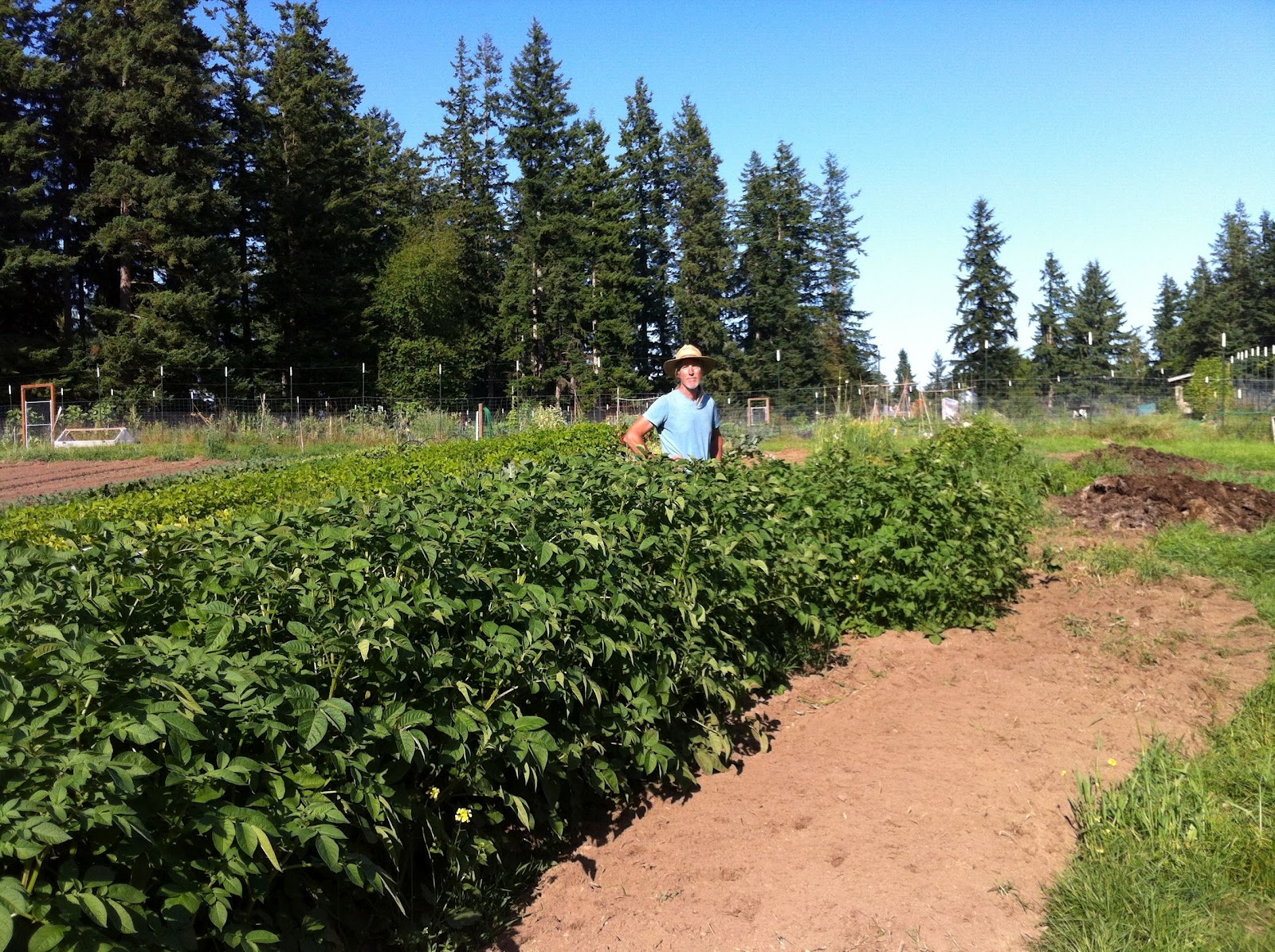
He can’t believe how well the vegetables are doing. The potato plants are the biggest he’s ever grown—waist-high. He planted a local variety that our friend has been growing on the Chinook land for many years. Squash and eggplants are also bigger than we've ever seen. Healthy, too!


The peas are harvested, shelled and in the freezer!

Chris feels that the plot is performing so well in large part due to the amount of biodynamic preparations he has used—particularly the Pfeiffer Compost Starter and its effects on the horse manure he used. We have also done two sprayings of horn manure, one barrel compost, and we used compost preparations in the pile. Chris also did some spraying of fermented horse tail tea that we made last fall, as a preventative for mold.


I am behind on spraying silica, but am committed to doing at least two in August and early September. I just purchased a unit of BD #501 gold, this is horn silica with potentized gold mixed in! I also have my own homemade silica prep, made from the crystals on our farm back in Kentucky.


Our horns are still buried in the garden. I need to check those in the next day or so. Normally one would dig them up in early June, but with the cool Northwest spring, they were still green inside. I wrote to Hugh Courtney, my friend and colleague from the Josephine Porter Institute and asked his thoughts on leaving the horns in the ground. He replied, “Remember that Steiner says of the BD #500 (horn manure) that they can be left in the ground until you are ready to use them. (Not so for BD #501 (horn silica), because leaving them in over the winter totally changes the forces picture in a Sensitive Crystallization test as Harvey Lisle demonstrated to both of us once upon a time.) So summer forces do not affect BD #500, and the daily in breath of the Earth is akin to the winter forces needed to transform BD #500.”


Chris is planning to do a class soon. Email him if you want to be notified when one is scheduled!

Saturday, July 21, 2012

Chris Sells Vegetables in Langley!


Chris planted quite a few trials this summer, testing varieties in preparation for a commercial scale market garden that will serve neighborhood customers beginning in early October, continuing through the winter.

He had enough excess cauliflower and cabbage to set up a table yesterday at the Second Street Market in downtown Langley.

It was a great chance for Chris to begin to share the news of the new Market Garden at the Anderson Farm, located at the corner of Al Anderson Ave and Fairgrounds Road.


 His plan is to create a membership-based garden, somewhere in between retail sales and a CSA. He is looking for a committed group of about 25 customers who will join the garden for a one-time fee, this will entitle members to purchase produce during regular weekly hours, or they can come and harvest on an honor-based system, once oriented to the garden.


Only organic and biodynamic agricultural practices are used.

If you would like more information, please call 221-0430 or email Chris at 90acres@whidbey.com.


Tuesday, June 26, 2012

Solstice Bees

Photos courtesy of Cary Peterson

After work on the day of the Summer Solstice, Chris innocently stopped to say hello to our friend Cary. She is the head gardener and volunteer coordinator at the Good Cheer Food Bank Garden.


She pointed out that a huge swarm of honey bees had just landed in a nearby tree.


Chris was able to throw together a bee suit, and Cary had a spare hive body.


Once the branch was cut and the bees laid in the box, the rest of the swarm slowly made their way into the hive.


Friends patiently made sure each bee was safely inside. No one was stung!

After the bees were safely captured, Chris made sure he got some close-up footage. Take a look at his pictures here.


The bees were driven to their new home at the Langley Community Garden on the Anderson Farm.

Wednesday, March 21, 2012

Chris's New Farming Adventure!


—Christy Korrow

Exciting news from Chris! After relocating from Kentucky, our home for the last 20 years, we have been warmly welcomed by the wonderful community of Langley, on south Whidbey Island, Washington. We had not planned to farm commercially here on Whidbey, though we knew we would still be growing a large family garden.

After being here just a short time, Chris had three people offer him farmland where he could develop a market garden. The offer was too good to pass by! In December, we bought him a one-way ticket to Kentucky, where he rented a large Budget rental truck, loaded up our tractor, bush hog, front end loader and Italian spading machine, braved the icy mountain roads, hauling the equipment back to Whidbey.

Fast forward to the first day of spring...

A hot box is now built up against the rental house where we live, filled with seed flats-- flowers, brassicas, early tomatoes and herbs.


Chris will be developing a 1/3 acre market garden in the city limits of Langley, on the property of the Anderson Family Farm. Dorothy is the third generation to tend this family farm. The farm is home to the Langely Community Garden, beginning its third year. Twenty families/individuals each tend an 18 x 18 foot plot. There is also a group who manages a small herd of milk goats, another group who raises chickens and there is a heifer and a young steer being raised for beef. Compared to running our own farm, it is a welcome change, and such an honor to have the opportunity to participate in this kind of community run farm, where many hands make light work.

The ground is about turned, and I just sprayed the first barrel compost on the soil, to celebrate the first day of spring and to welcome in Persephone's return.


The field is a sandy loam, with predominantly rhizome grass, which will be determined to keep growing, even after it has been plowed up. Chris is going to plant cover crops this spring, and plans to get the vegetables going later in the summer. The growing season is quite long here, and though the winters are quite dark, the temperatures remain mild, making it easy to grow into an extended summer season, fall and on into winter time. Our spinach patch thrived uncovered all winter, as did our cabbages. The vegetables don't grow much during the winter, but they hold well. It seems similar to what we are used to with our winter growing in Kentucky.

The land is on the corner of two somewhat well-traveled roads. Chris is planning to keep marketing simple, and by word of mouth, people will know that he is there in the field on certain days of the week. Maybe we'll try an honor system farm stand as well.

I honestly have to say I have mixed feelings about selling food again after so many years. On one hand, I am firmly committed to local food security, I believe it is one of the most important necessary social deeds for our time. I am also keenly aware of the continuing price disparity between what we pay for food on the grocery store shelves, and what kind of price a farmer can ask for vegetables so that he or she can actually come close to making a living wage. The joy of knowing we will be producing food for the community, the excitement of experimenting in a new climate where daylight goes on until after 9pm in the summer, to grow food in the city limits of a town, and be part of such an active community farm are the thoughts I am holding onto for now....

Wednesday, September 14, 2011

Biodynamic Gardening Class on Whidbey Island


Biodynamic Gardening and Farming
Workshop for Beginners
with Chris Korrow

Gardening with biodynamics and understanding what nature is telling us about our gardens.
Plus, making and spraying biodynamic preparations, Barrel Compost and Horn Manure (BD #500).

When: Saturday, September 24, 2011, 11am-early afternoon

Where: Langley Community Garden
(Anderson Family Farm: 1041 Al Anderson Ave, Langley, WA 98260), Whidbey Island

Call: 221-0430 (local) or 270-406-9116 (mobile)
Email: 90acres@accessky.net

Bring: A chair if you think you might need one, sun hat and water.

Cost: Fee by donation. Farm interns are free.

Chris has been farming and gardening organically and biodynamically for more than 20 years.
Learn more about Chris at www.breathedeepproductions.com

Friday, September 2, 2011

Random Localness


This yummy sauce is made here on Whidbey Island.


Gabbi and I picked blackberries today, she made tarts and cobbler.


Chris picked this horsetail yesterday, so we brewed up a big vat of tea for the garden. It's one of the nine biodynamic preparations, also known as BD #508. It helps combat fungus and mold, and regulates water forces. We'll spray it on plants, and use some in the compost piles.


Amy gave us these big green apples from her tree on Maxwelton. I can't remember what they are called. They taste like a yellow apple! So crisp and sweet.

Thursday, September 1, 2011

Local Food Challenge or Boy Am I Glad Washington is a Wine Producing State


—Christy Korrow

September, (starting now!) Chris, Gabe and I are participating in Transition Whidbey’s local food challenge to, as much as possible, eat foods grown within a 100 mile radius of our home on South Whidbey Island, Washington. Mind you, I have only lived here for six weeks, so I thought this challenge would be a good chance to learn more about our local food shed, and the rest of the family agreed to give it a try.

I also want to use this challenge as a chance to become more aware of what we eat in general. I expect it will be an interesting exploration and take me to the next level with my commitment to making the right food choices and remind me of the social and economic consequences of my and my family’s food choices.

I don’t want to attempt to eat “only local” for the month, instead I want to use the challenge time to examine my non-local food choices, and to discover new food choices that we can integrate into our family diet for a long time to come.

We are blessed to grow all of our own vegetables in a community garden within walking distance from home. Right now we have plenty of potatoes, chard, spinach, lettuce, carrots, onions, green beans, beets, what else...assorted herbs, cucumbers, zucchini. Right around the bend, we’ll have kale and collards with broccoli, cauliflower and cabbage coming on before winter. This seems to provide us with more than enough variety of vegetables. We buy an occasional avocado and also fruit. Neighbors and friends either give us eggs or we trade for produce.

Last month we ate a lot of bing and Rainier cherries (organic were available for almost the same price as conventional). Now plums, pluots and peaches are all for sale at the farmer’s markets. Since I am new to the area, I am not sure how long these fruit trees of Eastern Washington continue to produce. Blueberries from Oregon have been for sale at the grocery store, and yesterday, a friend brought by some apples from her tree.

With all of that, we still eat a lot of food that we don’t grow, and there are a number of foods we eat which might or might not be available locally.

I am hoping to meet with Georgina, a woman who is producing kamut, hard winter wheat and barley on a seven acre plot in the historic Ebey’s Landing National Historic Preserve. While her land is not Demeter Certified Biodynamic, Georgina uses biodynamic farming practices. I’d like to buy some locally grown wheat from her, although I have no grinder, so I am not sure how we will put it to use. I think she offers flour. The barley we could put in soups.

I spent over an hour on the internet trying to find out how to buy lentils grown in the Palouse region Eastern Washington, even though it is the (self-proclaimed) lentil capitol of the world and home to the National Lentil Festival. I finally did find a couple of sources, but nothing organic so far. Go figure.

So the challenge begins!

Thursday, April 14, 2011

4 Reasons to Eat Plants

Hello,

This is part of an assignment for a course called Nutrition Fundamentals, part of a series of courses in Plant-Based Nutrition (nutrition as a science and a component of medicine, to both maintain health and prevent disease) authored by Dr. Colin Campbell, which I am taking through eCornell. Dr Campbell is Jacob Gould Schurman Professor Emeritus of Nutritional Biochemistry at Cornell University (wow!) and many people know Dr. Campbell for his seminal work, published as The China Study, considered the largest and most comprehensive study of health and nutrition ever conducted. What I love about the course is the data and science to back up every claim!

Christy


My motivation for taking this course is my desire to be able to communicate clearly the facts and science behind the health benefits of a plant-based diet.


My strategy for provoking interest in this topic is to first begin with myself, and lead by example, and eat a plant-based diet as the basis for keeping myself in optimum health. As many have already mentioned, it is detrimental to push new ideas on a person who is not open to them. Additionally, if that person is already in the midst of an illness, he or she is struggling with so much already, therefore it is best to always leave people free to make their own choices, and understand that we might not always know what is best for another, and to still treat him or her with kindness and compassion.


Alternately, to those looking for answers, a few of the most convincing arguments for adopting a plant-based diet as a way of bringing about health are: it’s inexpensive; no side effects; it’s scientifically proven; it not only benefits your health, but also the health of the world.


It’s inexpensive:

As Dr. Campbell stated, we are currently spending more in the US per capita on healthcare than any other country in the world. Yet, we are not getting better health for all of this spending. We have been using costly pharmaceuticals for the last 50 years, substances which can only provide us with short term benefits, as we can see from the continued increase in disease rates. There is no evidence that these expensive treatments are bringing disease under control, and in fact cancer, obesity, diabetes and heart disease are all on the rise.


No side effects:

Medical care itself is the third leading cause of death in the US (with prescription drug adverse affects accounting for 106,000--almost half according to the JAMA).


Science:

Adopting a plant-based diet is not a fad, there is substantial scientific data showing the progress of plant-based diets in not only preventing, but reversing advanced late stages of heart disease—an example of the power of the dietary effect. Though the scientific community resisted accepting this, it is no longer disputable that advanced cases of heart disease can be reversed. Data has also shown that in societies where a Standard American Diet has crept in, high in meat and processed foods, a simultaneous rise in the diseases of cancer, diabetes, obesity and heart disease has been evidenced. Diet is a proven risk factor for both cancer and diabetes.


Worldwide implications beyond your own health:

By adopting a plant based diet, you are not only doing something for yourself, you are doing something for others. There are environmental, economic and political and implications to large-scale industrial meat production—ranging from overuse of resources, pollution, and disenfranchisement of peasant cultures.


Taking responsibility for your own health can be a big step for some, though the rewards are great!

Friday, February 4, 2011

Chris Harvests Winter Cabbage

Mature cabbages have stayed solid, healthy and sweet under a double layer of Reemay (agricultural fabric) this winter. They were mature by late October, and have kept wonderfully.

Thursday, June 10, 2010

Gabbi's Farm Internship at a Biodynamic Farm

Gabbi helping Earl to get going

While we have lived on a farm for 20 years now, for about the last 9, we haven't been a "working farm"--meaning we do not generate income from our farm. So while we have 3 horses, chickens, and grow a large garden, we no longer milk a cow, raise animals for meat and grow a few acres of vegetables like we used to. So when our 16 year old daughter, Gabbi, thought she would like to visit a neighboring farm and be an "intern" for a week, we thought it was a great idea.

Paul and Robin run Hill and Hollow CSA, delivering vegetable twice a week to Nashville, TN and Glasgow, KY. They have a milk cow, raise pigs, sheep, chickens, a donkey named Earl, and a pet turkey named Manly. Plus they grow many acres of vegetables, make compost and biodynamic preparations. There is a crew of 3 interns, along with their family of 4 (which includes their daughter Madeline and their son Sasha who is a full-fledged farmer at age 11). They are your typical bright wide-eyed brilliant children who have never been to school, raised on home-grown food and no television.

Sasha and Earl

In addition, Paul and Robin host the Nashville and Louisville Waldorf schools for their thrid grade farm visit each year, and pioneered the KY CRAFT (Collaborative Alliance for Regional Farmer Training) program, a program where the interns on organic farms from around the state meet each other, and visit and learn from other farmers.

It's very cool bit of trivia that Paul and Robin met when they were themselves interns at John Peterson's Angelic Organics (Star of The Real Dirt on Farmer John).

Gabbi was up at 5:30 am each morning to milk Addy with Sasha. After that, they spent an hour working with Earl. After a full day of farm work, the day came to a close, with Gabe again milking with Sasha and another session with Earl at dusk. (Video from John Bela)


For the last 5 years or so, Gabbi has practiced Parreli Natural Horsemanship, and received her Level 2 certificate last year. Parreli teaches how to solve train a horse and solve horse problems without force or punishment. Part of the reason Gabe wanted to head to Hill and Hollow was to have the chance to work with Earl, to begin to teach him how to pull farm equipment. He was pretty much spooking when something was behind him, kicking and hadn;t tied to pull anything. On her last day, Earl was fully hooked up in his tack, and successfully pulled the harrow around a dirt area. It was a good start. She hopes to go back in August for another week.

Earl about ready to pull the harrow

Paul and Robin had a send-off celebration for Gabe with a batch of homemade vanilla ice cream, and sent her home with a gallon of raw biodynamic milk and a 1/2 gallon of yogurt!

Sunday, June 6, 2010

30 Square Foot Garden Results


Our friend Pat Ritter created some garden beds using Chris’s instructions in his booklet, The 30 Square Foot Garden


She writes “...last year this was a large area we had to mow—and this year, well, see what I picked for a stir-fry dinner last night.  And will be better when it rains as I have a lot of little seedings just coming up—more greens.”


Thank you Pat, for sending the photos.