Chris is always exploring the details of patterns found in nature. Here are some shots from one of the Pacific Ocean beaches at Olympic National Park, Washington.
Wednesday, October 17, 2012
Beach Patterns
Labels:
art,
Chris Korrow,
Chris Korrow Photography,
environment,
nature
Sunday, September 9, 2012
What's For Sale?
Chris still has a few slots open for those who want to sign up to buy vegetables from now, through fall and winter.Call him at 221-0430 or email 90acres@whidbey.com.
The two regular pick-up days are:
Thursdays from 4 – 6 pm
Saturdays from 10 am – 12 pm
If you cannot come on one of those two days, Chris can make other arrangements with you. He can schedule a pick-up on another day, or orient you to the garden so you can come and harvest your own food, and note what you picked on a ledger pad he will keep in the shed. You can pay in advance and buy down your credit, or note what you take and he will invoice you at the end of the month.
Lettuce
Lettuce Mix
Diakon radish
Mustard
Spinach - is going crazy!
Snow Peas
Sugar snap Peas
Kale (three different varieties)
Swiss Chard
Bok Choy
Potatoes
Patty Pan Squash
Zucchini
Parsley
Cutting Celery
Cauliflowers, Broccoli & Cabbages in the next week or so.
Saturday, September 8, 2012
Gardening Class: Demystifying Biodynamic Gardening
Sunday, September 16
From 12 – 2pm
Where:
Market Garden at the Anderson Farm, the corner of Fairgrounds Road and Al Anderson Avenue (next to the Langley Community Garden P-patch)
Most gardening and farming practices use material inputs (npk) when trying to improve plant health. Biodynamic farming and gardening takes into consideration the interconnectedness of all life in and around the farm and garden, with the understanding that we are looking for living nutrients when we want to grow nutritional food for people.
Chris Korrow will explore these relationships and how they make a difference in plant health and soil fertility. Topics such as companion planting, plant spacing, micronutrients, planting though the seasons, biodynamic compost, how to deal with early bolting, and the connection between water, soil and temperature will also be discussed.
$15 includes biodynamic preparations that you can take home and use in your own garden!
For more information email 90acres@whidbey.com or call 221-0430.
Preregistration requested, there is room for a limited number of participants.
Chris is developing a membership garden for those who want to buy produce from now through winter (he will focus on fall and winter production). More info will be available, or you can sign up at the event. Vegetables will be available for sale at the class.
From 12 – 2pm
Where:
Market Garden at the Anderson Farm, the corner of Fairgrounds Road and Al Anderson Avenue (next to the Langley Community Garden P-patch)
Most gardening and farming practices use material inputs (npk) when trying to improve plant health. Biodynamic farming and gardening takes into consideration the interconnectedness of all life in and around the farm and garden, with the understanding that we are looking for living nutrients when we want to grow nutritional food for people.
Chris Korrow will explore these relationships and how they make a difference in plant health and soil fertility. Topics such as companion planting, plant spacing, micronutrients, planting though the seasons, biodynamic compost, how to deal with early bolting, and the connection between water, soil and temperature will also be discussed.
$15 includes biodynamic preparations that you can take home and use in your own garden!
For more information email 90acres@whidbey.com or call 221-0430.
Preregistration requested, there is room for a limited number of participants.
Chris is developing a membership garden for those who want to buy produce from now through winter (he will focus on fall and winter production). More info will be available, or you can sign up at the event. Vegetables will be available for sale at the class.
Tuesday, July 31, 2012
Biodynamic Preps and Giant Potato Plants
—Christy Korrow
Chris is charged up about his market garden. He is on track to have crops for sale beginning in early October, and hopes to supply customers through the winter. His plan is to create a membership garden—somewhere between a farm stand and a CSA.
He likes the idea of people becoming members at a $50 fee. It gives him the security of knowing he has a dedicated customer base. It will also give the customers more flexibility than a CSA—more choice of variety, how much they want to spend, and flexibility time-wise. He hopes he can orient people to the garden to the point where they can even go in and harvest on their own, and write down what they take in a note book, using an honor-based credit system.
He has a few members already and the space is limited, so email him if you’re interested!
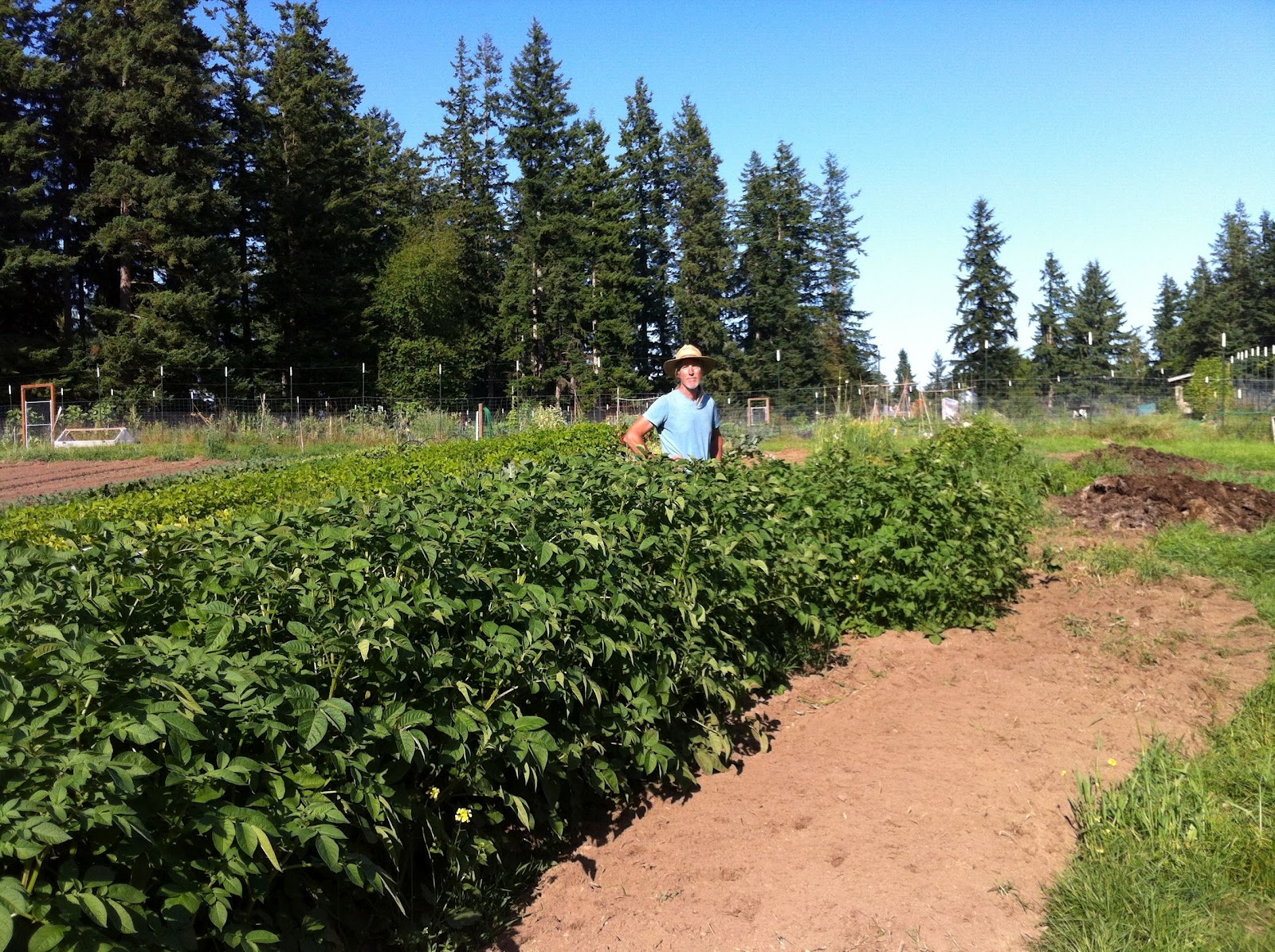
He can’t believe how well the vegetables are doing. The potato plants are the biggest he’s ever grown—waist-high. He planted a local variety that our friend has been growing on the Chinook land for many years. Squash and eggplants are also bigger than we've ever seen. Healthy, too!
The peas are harvested, shelled and in the freezer!
Chris feels that the plot is performing so well in large part due to the amount of biodynamic preparations he has used—particularly the Pfeiffer Compost Starter and its effects on the horse manure he used. We have also done two sprayings of horn manure, one barrel compost, and we used compost preparations in the pile. Chris also did some spraying of fermented horse tail tea that we made last fall, as a preventative for mold.
I am behind on spraying silica, but am committed to doing at least two in August and early September. I just purchased a unit of BD #501 gold, this is horn silica with potentized gold mixed in! I also have my own homemade silica prep, made from the crystals on our farm back in Kentucky.
Our horns are still buried in the garden. I need to check those in the next day or so. Normally one would dig them up in early June, but with the cool Northwest spring, they were still green inside. I wrote to Hugh Courtney, my friend and colleague from the Josephine Porter Institute and asked his thoughts on leaving the horns in the ground. He replied, “Remember that Steiner says of the BD #500 (horn manure) that they can be left in the ground until you are ready to use them. (Not so for BD #501 (horn silica), because leaving them in over the winter totally changes the forces picture in a Sensitive Crystallization test as Harvey Lisle demonstrated to both of us once upon a time.) So summer forces do not affect BD #500, and the daily in breath of the Earth is akin to the winter forces needed to transform BD #500.”
Chris is planning to do a class soon. Email him if you want to be notified when one is scheduled!
Thursday, July 26, 2012
Upper Langley Co-Housing Neighborhood Site Plan
Our site plan is well underway and heading toward finalization.
Learn more about this project to create a green, affordable co-housing neighborhood in Langley, Washington that will be accessible to low-income residents.
Labels:
Chris Korrow,
Christy Korrow,
Upper Langley,
Whidbey Island
Subscribe to:
Posts (Atom)